Vorträge
Mittwoch, 11. März 2026, 18:30–20:00 Iida Tetsunari: „Fifteen Years After 3.11: A Dramatically Changed World and Japan’s Energy Landscape“
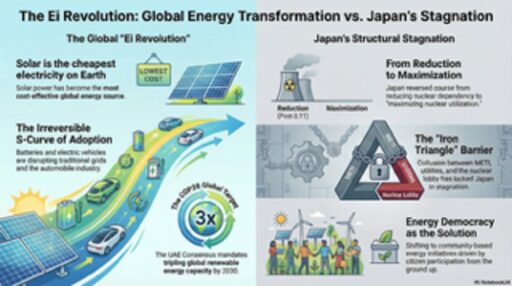
The world is undergoing a civilizational energy transformation—what Iida calls the “Ei Revolution” (Electricity × intelligence). Solar power has become the cheapest electricity source on earth; batteries are reshaping grids and mobility; and electric vehicles are disrupting the automobile industry through an irreversible S-curve of adoption. Nations from China to Europe are racing ahead, and the COP28 “UAE Consensus” set a global target to triple renewable energy capacity by 2030.
Yet Japan—the very country that experienced the Fukushima Daiichi nuclear disaster—has been left behind. Fifteen years after 3.11, the “nuclear emergency declaration” remains in effect, while the government has reversed course from “reducing nuclear dependence as much as possible” to “maximizing nuclear utilization.” A fatally flawed feed-in tariff, a backlash against renewables orchestrated by entrenched interests, and the absence of energy democracy have locked Japan into a path of stagnation.
Drawing on his book Ei Revolution: The Evolution toward Energy Intelligence and Japan’s Path Forward (Shueisha, 2026), Iida will illuminate the full scope of this global transformation, diagnose why Japan has failed to change, and chart a path forward—one driven by community-based energy initiatives and democratic participation from the ground up.
Key Themes
■ The Ei Revolution: Solar, batteries, and EVs as the protagonists of a new energy civilization
■ Germany vs. Japan: Why a model student and the country of Fukushima stand worlds apart
■ The Structural Pathology: How the “iron triangle” of METI, utilities, and the nuclear lobby reversed Japan’s course
■ Community Power & Energy Democracy: Changing Japan from the ground up through local energy transitions and citizen participation
About the Speaker
Iida Tetsunari is Chairperson of the Institute for Sustainable Energy Policies (ISEP) and a leading authority on renewable energy policy in Japan. He holds a graduate degree in nuclear engineering from Kyoto University and completed doctoral coursework at the University of Tokyo. After working in the nuclear industry, he conducted renewable energy policy research in Scandinavia before founding ISEP.
A pioneer of community energy in Japan, Iida drafted the country’s first feed-in tariff proposal in the late 1990s and launched Japan’s first green power certificates, citizen wind farm, and citizen fund (all in 2001). He has led regional energy policy innovation in Tokyo, Yokohama, Fukushima, and Nagano, and serves on the Steering Committee of REN21 and IRENA task forces. He received the World Wind Energy Association Honorary Award in 2016. His latest book, Ei Revolution, Shueisha was published in January 2026.
Vortrag in englischer Sprache.
Moderation: Prof. Dr. Sven Saaler

Dies ist eine Veranstaltung mit freundlicher Unterstützung der Friedrich-Ebert-Stiftung.
Time: 6.30-8.00 p.m. (Japan), 10.30-12.00 a.m. (MESZ)
Zoom-Link: https://us02web.zoom.us/j/88927058712?pwd=9VDLKbSW6aLJRIOZ7fFSPCfqfT4LeZ.1
Meeting ID: 889 2705 8712
Passcode: 994101